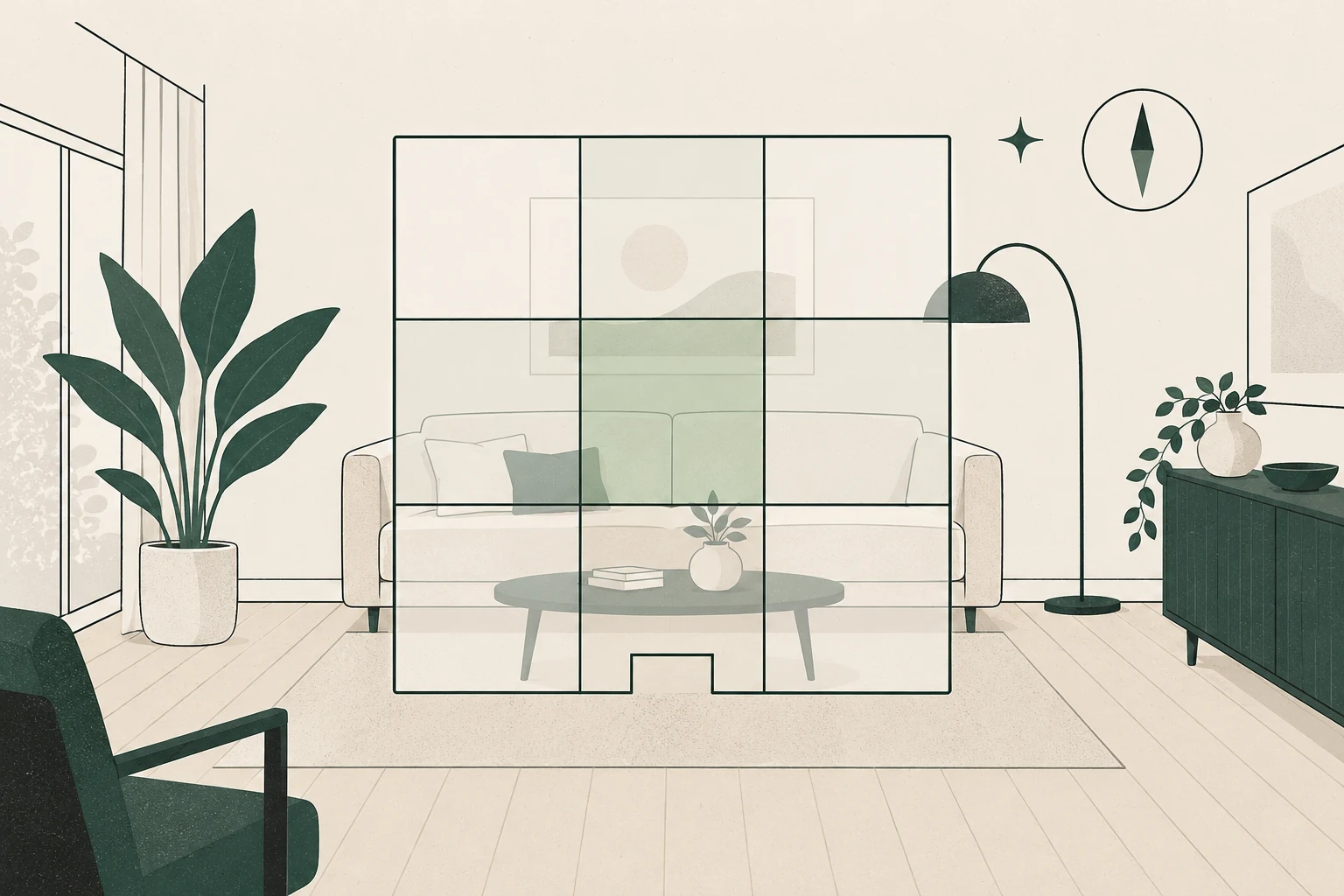
A bagua map living room exercise can organize observation, but only after you name the system you are using. Door-aligned Western methods and classical compass methods do not orient the map in the same way.
This beginner guide demonstrates a simple door-aligned grid as a reflective tool. It does not claim that changing one sector guarantees wealth, health, love, or any other life outcome.
Difficulty: Beginner
Estimated time: 30–45 minutes
Prerequisites: A roughly rectangular floor plan and a willingness to treat symbolism as inquiry rather than prediction
What you’ll need
- A measured or sketched living-room plan
- Pencil, ruler, and tracing paper
- The position of the room’s main entrance
- Notes about current use, light, damage, and clutter
- One clearly named bagua method
Quick overview
| Step | Action | Time |
|---|---|---|
| 1 | Choose and name one approach | 5 min |
| 2 | Draw the room and divide it into nine areas | 10 min |
| 3 | Align the entrance wall | 5 min |
| 4 | Observe each area without diagnosing | 10 min |
| 5 | Make one practical, reversible adjustment | 5–15 min |
What the bagua is—and is not
Bagua means “eight trigrams” and has meanings beyond the simplified nine-area charts common in Western interiors. Feng shui schools use related concepts in distinct ways. The International Feng Shui Guild’s glossary is one useful starting point for terminology, while a lineage-specific teacher is better for formal practice.
In a living room, a bagua overlay can prompt questions about attention and meaning. It is not a diagnostic instrument, scientific measurement, or substitute for inspecting a leak, overloaded outlet, unsafe heater, or accessibility barrier.
Step 1: Choose and name the approach
For this exercise, use a door-aligned nine-area grid, often associated with BTB or Western feng shui. Stand outside the living room looking in. The entrance wall becomes the near edge of the map.
Classical compass practice uses directional readings and may consider time and wider site conditions. Do not rotate a door-aligned chart toward magnetic north halfway through the exercise. If classical practice matters to you, learn from a qualified practitioner in that lineage.
Some teachers apply a bagua to the whole home and then to individual rooms. Anjie Cho describes the map as usable at different scales. For clarity, record whether this is your primary whole-home map or a secondary room exercise.
Tip: Write “door-aligned room bagua” at the top of your paper. That label prevents methods from quietly blending together.
Step 2: Draw the living room and create nine areas
Draw the room’s usable footprint, including recesses and projections. Mark the main entrance, other doors, windows, and fixed features. If the room is irregular, begin with the simplest bounding rectangle and note the unusual area rather than forcing false precision.
Overlay a three-by-three grid. The nine equal zones are commonly labeled, from the entrance edge upward:
| Near edge | Middle | Far edge |
|---|---|---|
| Knowledge / self-cultivation | Career / life path | Helpful people / travel |
| Family / ancestors | Center / well-being | Children / creativity |
| Wealth / abundance | Fame / reputation | Partnership / relationships |
English labels vary by teacher and translation. Treat them as themes for reflection, not fixed promises.
Warning: Do not let a symbolic grid obscure the room’s physical facts. A blocked exit remains a blocked exit in any sector.
Step 3: Align the entrance wall
Place the bottom edge of the grid along the wall containing the living-room entrance. Depending on the door’s position, it will enter through the knowledge, career, or helpful-people area in this system.
If the room has two equally used entrances, choose the one that functions as the primary approach from the home’s main circulation. Record the other opening because it still affects movement. If you cannot identify a primary entrance, the room may be better studied first through form and circulation rather than a bagua overlay.
Success looks like: Another person can see exactly how you aligned the map and which method you used.
Step 4: Observe the nine areas without diagnosing your life
Move through each zone and record only what you can observe:
- Furniture and objects present
- Light, temperature, sound, and wear
- Damage or unfinished maintenance
- Whether the area supports the room’s stated purpose
- Personal associations with the objects there
Then ask a thematic question. In a creativity area, for example: “Does this part of the room make it easy to draw, play, or display work we care about?” In a partnership area: “Can two people sit or complete a shared activity comfortably?”
Avoid the leap from “this corner is crowded” to “this causes relationship trouble.” The first statement is an observation; the second is an unsupported life claim.
Step 5: Make one practical, reversible adjustment
Choose the zone where a small change supports both the theme and the room’s real use. Repair a lamp, clear access to a chair, group family photographs intentionally, or remove an object that feels obligatory rather than meaningful.
Use what you have first. A bagua is not a shopping grid. Color, material, artwork, or plants may be added later, but only if they suit actual light, care, safety, and taste.
Live with the adjustment for a week. Evaluate it by ordinary evidence: Is the surface easier to use? Does the seat invite conversation? Is the route clearer? Does the display feel more intentional?
Troubleshooting common bagua problems
The room is L-shaped
Symptom: The nine-square grid does not fit neatly.
Cause: The room has an extension or missing corner.
Fix: Draw the real outline inside a bounding rectangle, note the irregularity, and focus on function. Seek lineage-specific guidance before making a technical interpretation.
Online maps disagree
Symptom: One map places “career” at the door while another places north there.
Cause: The maps use different schools or orientations.
Fix: Identify each source’s method. Use one coherent system for the exercise.
One zone lands outside the room
Symptom: A balcony, recess, or missing corner complicates the overlay.
Cause: Simplified diagrams assume regular footprints.
Fix: Record the condition without treating it as a threat. Work first with the usable room and consult a practitioner if formal interpretation matters.
A symbolic recommendation feels unsafe
Symptom: Advice suggests placing a plant, mirror, or furniture in a route.
Cause: The suggestion ignores the actual floor plan.
Fix: Do not use it. Safety, access, care requirements, and building constraints take priority.
Frequently asked questions
Should I use the bagua on one room or the whole house?
Both approaches appear in contemporary teaching. Record the scale you chose. A room overlay is best treated as a secondary, focused exercise rather than proof that the wider site does not matter.
Which wall is the bottom of a door-aligned bagua?
The wall containing the primary entrance to the mapped space. This answer applies to the door-aligned method described here, not every feng shui school.
Can I use a phone compass instead?
A compass reading belongs to a different method. If you want classical analysis, learn the reading process, site context, and interpretation as a coherent system rather than swapping a compass into a Western grid.
Do I need an object in every area?
No. Empty space can be functional. Maintenance, access, and meaningful use matter more than filling nine zones.
Use the map as a question, not a verdict
A careful living room bagua exercise names its method, documents the floor plan, separates observation from prediction, and ends with one reversible change. That approach respects both the tradition’s complexity and the reader’s real room.
For context before mapping, read what feng shui means in a living room. If an online rule turns an irregularity into a threat, use the gentler guide to common feng shui mistakes to separate observation from alarm. Then compare your findings with the complete living room layout guide.