Clutter is not a character flaw. It often means a room is doing more jobs than its layout or storage can support: relaxing, working, playing, exercising, hosting, passing through and holding objects from elsewhere.
A feng shui approach can begin with flow—how people, attention and ordinary activities move through the room. Here, “flow” is an observation tool, not a claim that clearing a shelf will change your luck.
Smallest useful action: Clear one route from the entrance to the main seat. Stop when that path is comfortable. You have already improved the room.
Define what the room needs to support
Write the room’s current jobs in plain language. Include the inconvenient ones. “Laundry sorting twice a week” is more useful than pretending the room is only for calm conversation.
Then sort the jobs into three groups:
- Primary: happens most days and deserves the easiest space.
- Occasional: needs a workable setup but can be stored between uses.
- Accidental: migrated here because it has no home or because another area is harder to use.
This step changes the question from “How do I hide everything?” to “What must be easy here?” If a work laptop is used daily, it needs a real landing place and cable plan. If shoes pile up because the living room is beside the entry, solve that handoff rather than blaming the people who live there.
Clear paths and working surfaces first
Begin with function, not sentimental decisions.
- Open the entry route. Move bags, cords, stools and low tables that create a trip or turning obstacle.
- Recover one seat. A chair used as storage cannot support the room’s purpose.
- Clear one working surface. Choose the coffee table, side table or media console—not all of them.
- Restore controls. Make switches, remotes, window handles and vents usable.
- Remove obvious waste and dishes. Do not mix cleaning with complex possession decisions.
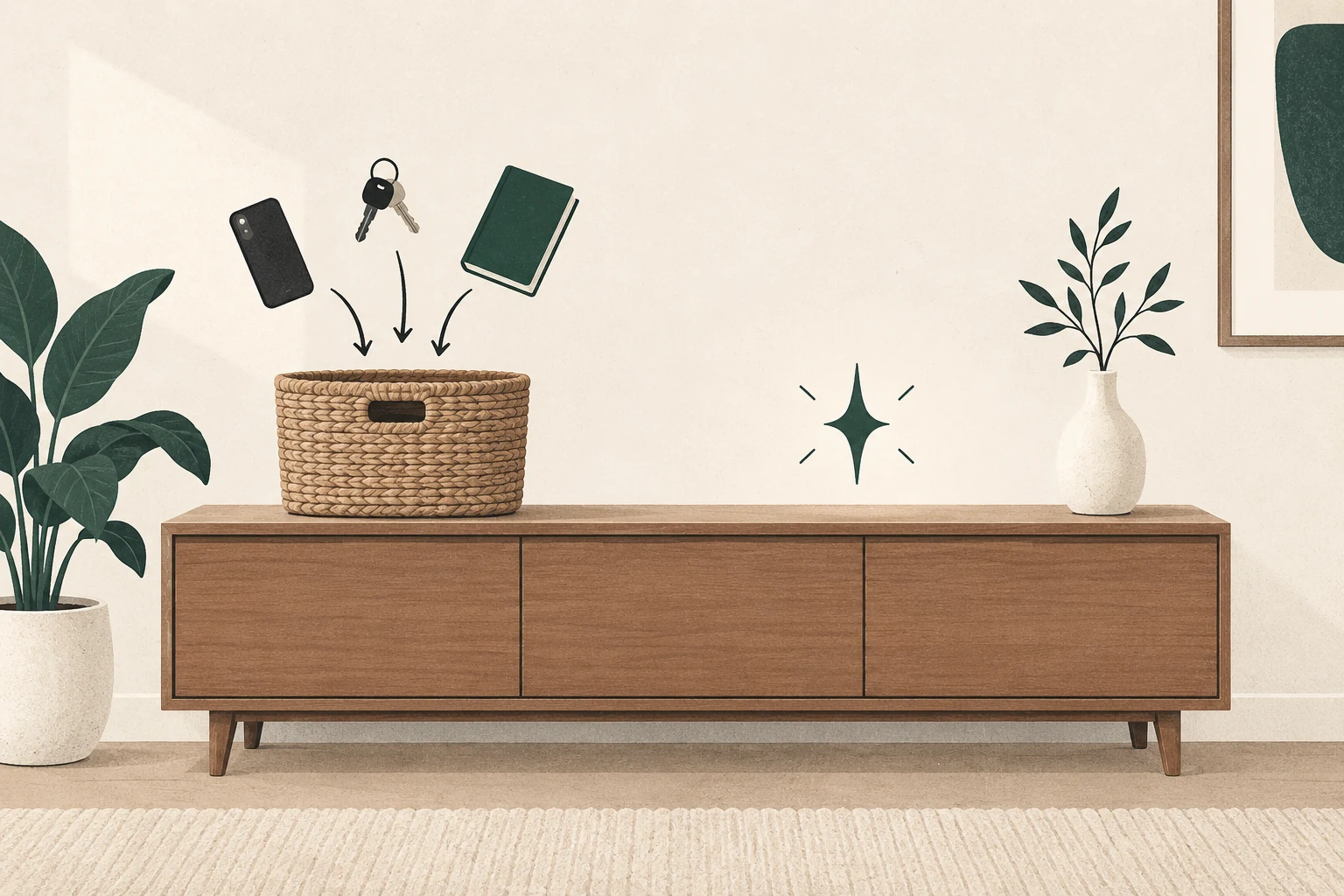
Use a single open basket for items that belong elsewhere. Distribute it at the end of the session so the basket does not become permanent storage.
If furniture itself blocks movement, pause the declutter and consult the living-room furniture placement guide. A narrow route cannot be organized into becoming wide.
Decide what stays without shame
Work in one small category or zone. For each item, ask:
- Is it used in this room?
- Does it support a current household member, activity or memory?
- Is it complete and in usable condition?
- If it belongs elsewhere, where is that exact place?
- If it leaves, does it need to be donated, recycled, repaired, returned or safely discarded?
“Keep” is a valid answer. The aim is not an empty room; it is a room whose contents can be used and maintained. If an item is emotionally difficult, place it in a clearly dated decision box and choose a review date. Do not create an indefinite hidden category.
When energy or mobility is limited
Use ten-minute sessions or one reachable surface. Keep a stable chair nearby and avoid carrying loads that affect balance. Ask for help with heavy furniture, ladders, electrical equipment or disposal. Accessibility and safety override an idealized image of minimalism.
When several people share the room
Give each person a defined, reachable home for frequently used things. A small labelled basket inside a cabinet is more humane than expecting everyone to remember a complex styling system. Agree on what “reset” means together: perhaps clear the path, return dishes and make one seat available.
Build storage around retrieval
Buy storage only after you know what is staying and how often it is used.
| Frequency | Best position | Example |
|---|---|---|
| Daily | visible or one easy action away | remote tray, reading basket |
| Weekly | nearby closed storage | game drawer, exercise accessories |
| Seasonal | labelled higher or farther storage | spare throws, holiday objects |
| Never used | decide, do not warehouse by default | broken or duplicate items |
Containers should not make a path narrower, block a vent or create a climbing hazard. Secure top-heavy furniture and televisions according to manufacturer directions; the CPSC’s Anchor It guidance recommends properly securing TVs and top-heavy furniture.
Worked example: the living room beside the front door
If shoes, mail and charging cables collect on the nearest chair, the problem is a missing handoff—not three unrelated bad habits. Clear the chair, place one existing basket or tray at the arrival point, route the charger safely and set a weekly time to empty the mail. If the landing place overflows, reduce what it is expected to hold instead of buying a larger container automatically.
Use feng shui questions as a second pass
Once the room works, notice its sensory and symbolic layer:
- What is the first thing seen from the doorway?
- Does the main seat feel exposed to traffic or supported by the plan?
- Are meaningful objects visible, or are they lost among unrelated items?
- Does a mirror repeat a calm view or double visual noise?
- Is the light sufficient for the room’s real activities?
Different feng shui schools may interpret these observations differently. Choose adjustments that also make practical sense. For example, moving a stack away from a door improves physical access regardless of symbolic interpretation.
Build a reset that lasts
A room reset should match the way the household already moves.
After-use reset: two minutes
- return cups and dishes;
- place remotes in their landing spot;
- fold or drape the throw;
- clear the main route.
Weekly reset: fifteen minutes
- empty the “belongs elsewhere” basket;
- wipe one working surface;
- return the seating group to its useful position;
- check plants, bulbs and loose cables;
- choose the next activity the room needs to support.
The companion guide to simple living-room rituals turns this sequence into a repeatable pause without making supernatural promises.
When fifteen minutes is unrealistic, use the bounded five-minute living room reset to restore one route, one surface, seating and light—then stop on time.
What not to do
- Do not empty the entire room unless you have time, support and a re-entry plan.
- Do not buy matching containers before deciding what stays.
- Do not frame another person’s necessary equipment as a spiritual problem.
- Do not block exits, heaters, vents or accessible routes to make the room look tidier.
- Do not use clutter language to moralize poverty, disability, grief, caregiving or a busy season of life.
Your next useful step
After clearing one path and one surface, sit down. Notice whether the room is easier to enter, use and leave. That is enough evidence for the next small adjustment. When the contents are under control, use the living-room layout guide to decide whether the furniture itself should move.
Sources and editorial note
Safety guidance is cross-checked against the US Consumer Product Safety Commission’s Anchor It program. Feng shui language is used as a reflective framework; this article does not promise health, financial or relationship outcomes.