The most damaging feng shui living room mistakes are rarely a missing crystal or the “wrong” lucky color. They are arrangements that make the room harder to enter, use, share, or maintain—and advice that turns an ordinary compromise into a source of fear.
These nine corrections begin with function. Each includes a no-purchase action, because the first response to a room problem should not be a shopping list.
1. Treating the main route as leftover space
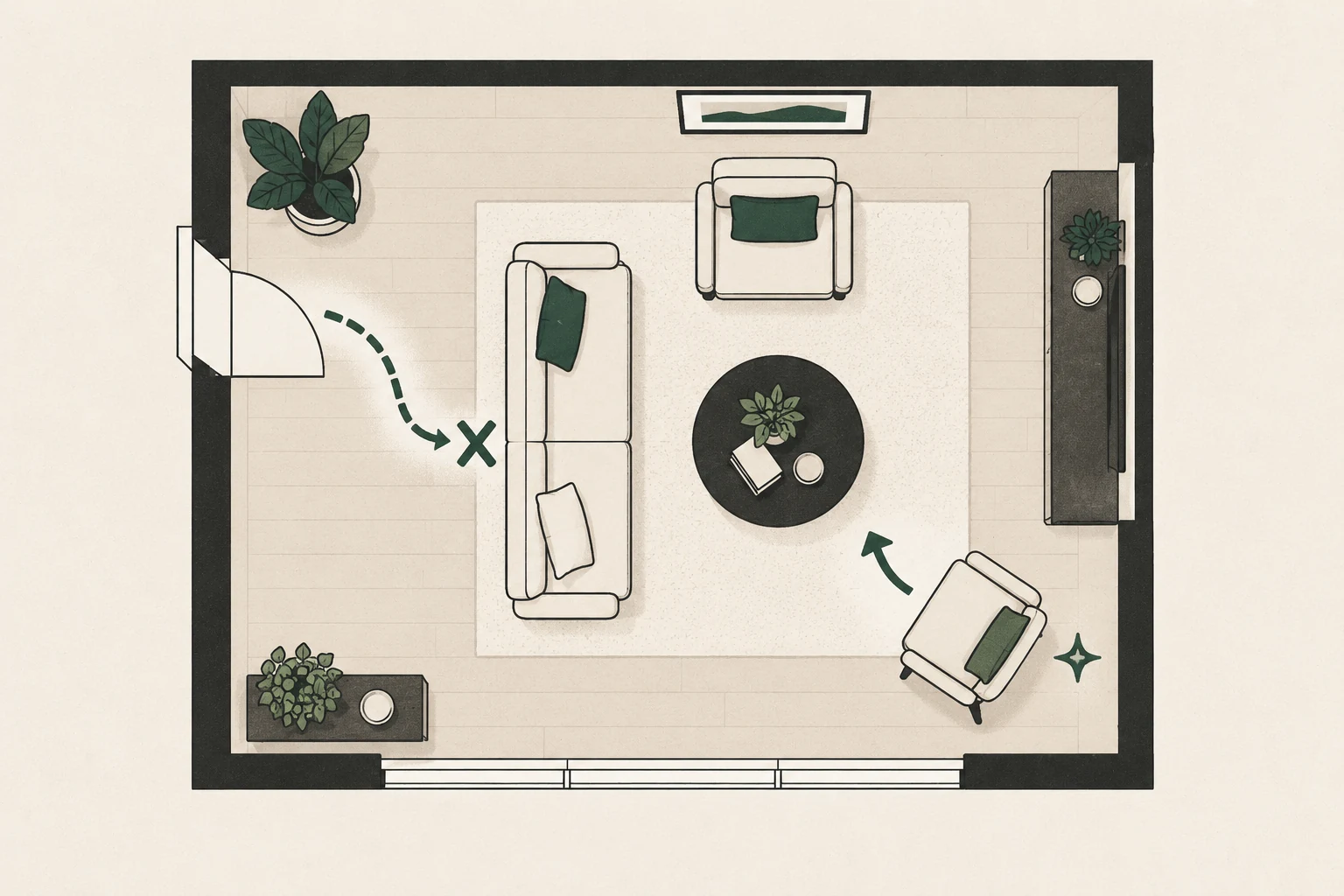
A route is not whatever remains after the furniture is placed. It is part of the plan.
Stand at the main entrance and trace the path to the next doorway and the most-used seat. If a coffee table, chair, basket, or plant forces a sharp detour, move that item first. For a person using a mobility aid, measure for the actual device and turning movement rather than a decorative rule of thumb.
Try this: Remove one obstacle for three days. Notice whether the room becomes calmer simply because people stop negotiating the same pinch point.
2. Forcing a “command position” that creates new problems
Many practitioners prefer the main seat to see the entrance and have support behind it. The idea can improve awareness, but not if it blocks a window, overheats a sofa against a radiator, or narrows an accessible route.
Choose the strongest available position, not an imaginary perfect one. A floating sofa can gain support from a rug, slim console, or lighting pair. A sofa under a window can work when the window, curtains, temperature, and safety all remain manageable.
Try this: Improve entry awareness with a chair angle or better lighting before moving the heaviest piece.
3. Aiming every seat at the television
A screen-first layout can make conversation feel incidental. That does not mean the television must disappear.
Angle one chair toward the sofa, add a movable stool, or place the screen slightly off the room’s visual center. The goal is a seating group that can shift between media and people.
Try this: Turn the television off and photograph the room from the doorway. If all the furniture still appears to wait for the screen, rotate one light chair.
4. Filling every symbolic area
A simplified bagua chart can become a nine-part shopping prompt: a plant here, red object there, mirror elsewhere. This mistakes symbolic association for required inventory.
Feng shui schools differ in how they orient and interpret the bagua. Begin by naming the method, then use each area to ask what is maintained, used, or meaningful. Empty space may be exactly what a small room needs.
Try this: Before adding an object, repair, clean, or remove something in the area. See the living room bagua guide for a method-conscious exercise.
5. Using mirrors as automatic cures
A mirror repeats whatever it reflects. It may expand light and view, but it can also duplicate clutter, a bright screen, or an exposed doorway. Heavy mirrors also need secure installation suitable for the wall and household.
Hold a small mirror in the proposed position and examine the reflection from the main seats. Check it during the day and after dark. If the view feels busy or produces glare, the mirror is not helping simply because a rule recommended one.
Try this: Improve the original view before multiplying it.
6. Adding plants where the room cannot support them
Plants are commonly associated with wood energy and vitality, but a struggling plant in a dark corner does not create an uplifting result. Species also vary in toxicity to pets and children.
Choose for actual light, temperature, care capacity, and safety. Do not narrow a route or hide a damaged wall with foliage that will be difficult to maintain.
Try this: Move an existing healthy plant to a suitable visible location rather than buying one for a symbolic corner.
7. Confusing more decor with more balance
Balance is relational. It may come from weight, empty space, height, texture, light, or repeated color—not matching objects in every corner.
When a room feels unsettled, remove small competing items and identify the main visual anchor. A strong sofa group, useful lamp, meaningful artwork, or clear view can carry more presence than several symbolic accessories.
Try this: Clear one surface completely, then return only what supports a task or matters to the household.
8. Ignoring glare, heat, cords, and maintenance
Symbolic advice should never obscure physical conditions. The U.S. Department of Energy explains that window orientation and shading affect daylight, glare, and heat. A sofa may feel agitating because afternoon sun hits the sitter’s eyes, not because of an invisible flaw.
Likewise, stretched extension cords, unstable furniture, blocked vents, and unsuitable fireplace clearances need direct remedies. Follow manufacturer instructions and qualified professional guidance.
Try this: Observe the room at the difficult time of day. Adjust a shade, lamp, cable, or seat angle based on the problem you can identify.
9. Turning every compromise into “bad feng shui”
Small homes, rentals, shared households, mobility needs, pets, and budgets create legitimate constraints. A layout can be imperfect and still be supportive.
Fear-based advice weakens your ability to observe. Replace “Is this bad?” with three better questions:
- What friction does this arrangement create?
- Who experiences that friction?
- What is the smallest safe change we can test?
This shift keeps traditional ideas in conversation with real life instead of using them as a verdict.
When safety overrides symbolism
Safety and access are not competing schools of feng shui. They are basic responsibilities.
Ignore any recommendation that asks you to:
- Block an exit, door swing, or necessary route
- Place fabric, furniture, or electronics too close to a heat source
- Leave a heavy mirror or tall unit unsecured
- Create a trip hazard with cords, rugs, or low objects
- Reduce access for a household member or caregiver
- Substitute a decorative cure for repair by a qualified professional
The 2010 ADA Standards are written for covered facilities, not as a universal residential code, but their clear-route and maneuvering-space diagrams can help people think more generously about access. Personalized needs and local rules still govern the home.
A five-minute correction
Do not fix nine things at once. Choose the room’s most repeated friction—usually a blocked path, unsupported seat, inaccessible light, or crowded surface. Make one reversible change and live with it.
A better living room is not one that passes every internet checklist. It is one where people can arrive, settle, connect, and move with less effort. Continue with the furniture placement guide or return to feng shui living room foundations when a rule needs context.