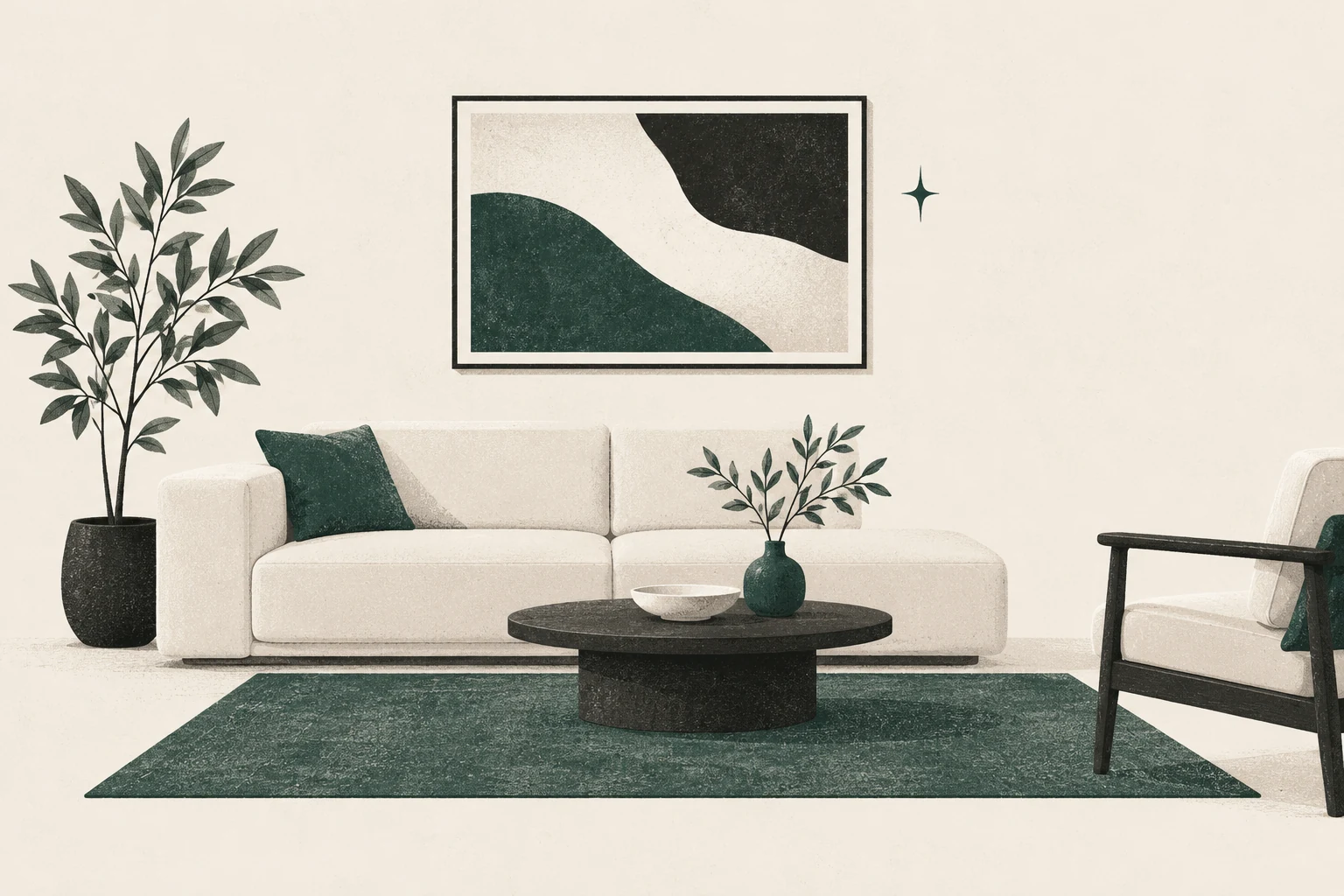
Art can set the emotional direction of a living room. A rug can make separate chairs and a sofa read as one place to gather. In feng shui practice, both may also carry symbolic meaning—but symbolism is most useful after the objects fit the room, support its purpose and stay safely in place.
You do not need a prescribed picture, colour or “lucky” motif. Start with what you already own and with the experience you want the room to support.
Smallest useful action: Remove one distracting object, then temporarily mark the proposed artwork and rug edges with painter’s tape. Look from the entry and every seat before buying or making holes.
Use art to support the room’s purpose
Name the room’s primary job in plain language: conversation, quiet reading, family play, film nights, formal hosting or a mix. Then ask whether the artwork reinforces that purpose.
- A calm landscape, abstract field or personally meaningful photograph may support a restorative room.
- A lively graphic work may suit a social room, but it can compete with a television, fireplace or strong view.
- A grouped collection can tell a family story when the frames share a boundary or spacing rhythm.
- One large piece can reduce visual noise when many small objects already occupy the room.
The subject does not have to look traditionally “feng shui.” Pay attention to your actual response. If an inherited picture evokes distress, obligation or a memory you do not want in the room, you are allowed to store, relocate or pass it on. If an unconventional work makes the household feel welcome and connected, that lived meaning matters.
Feng shui schools and practitioners interpret imagery differently. Treat suggestions about mountains, water, pairs, animals or colours as cultural and symbolic readings—not promises of wealth, health or relationship outcomes.
Choose art scale before interpreting symbolism
Artwork behind a sofa should relate to the furniture beneath it, not float as a tiny isolated object. Test the overall footprint with paper, cardboard or painter’s tape. Include the outer edges of a frame or of the full gallery grouping.
Stand in the doorway and sit in the main seats. Check whether the composition:
- feels connected to the sofa or console below it;
- leaves enough open wall to breathe;
- can be viewed without craning the neck;
- remains visible when lamps, plants or heads are in the foreground; and
- competes with another focal point.
There is no universal percentage or mounting height that works in every room. Sofa height, ceiling height, frame depth, sightlines and the viewers’ seated eye levels all change the answer. Use common decorating ratios as starting hypotheses, then test the real wall.
For a gallery wall, arrange the frames on the floor first. Photograph two or three versions and choose the clearest outer shape. Consistent gaps often create more calm than matching every frame.
Art behind a sofa: support and mounting safety
Some feng shui interpretations describe a solid wall behind the main seat as supportive. Artwork does not remove that support simply because it occupies the wall. The more practical questions are whether the piece feels visually steady and whether it is securely mounted.
Avoid balancing heavy frames on a narrow ledge above heads. Match fixings to the wall construction and the object’s weight, follow the hardware manufacturer’s instructions, and use qualified help when the substrate or load is uncertain. Consider acrylic rather than glass where breakage risk is a concern.
In a rental, a light textile, an existing picture rail or a smaller lightweight work may offer a reversible solution. Adhesive strips are not universal: verify surface, weight, curing and removal requirements, and never use them where a fall could injure someone.
If the sofa sits in front of a window, do not force artwork into the arrangement. Let the view and daylight be the visual field, then place art on an adjacent wall where glare and mounting are easier to manage. See the sofa placement guide for the wider support-and-sightline decision.
Anchor seating with the rug
A rug works best when it makes the seating group legible. It should help a sofa, chairs and table feel related instead of creating a small island that every piece avoids.
Three useful starting patterns are:
- All seating legs on the rug. This creates a clear zone in a large room, provided the rug does not crowd walls, doors or floor vents.
- Front legs on the rug. Often practical in an average living room because it connects the seats while limiting rug size.
- A compact rug centred within the group. This can work when no seat can overlap it, but the rug should still relate visibly to the furniture rather than resemble a loose mat.
Do not apply one formula mechanically. An angled chair, chaise, wheelchair turning space, floor register or unusual fireplace may call for an asymmetric but more usable result.
Use the measured furniture-placement method to protect doors and main routes before deciding on rug size.
Prevent curled edges, sliding and blocked routes
Rugs are walking surfaces, not only colour fields. The U.S. Consumer Product Safety Commission has identified carpets and rugs in a meaningful share of documented trips over obstacles among older adults. That does not mean every rug is unsafe; it means edge condition, backing and placement deserve a real check.
- Keep a rug out of a door swing and away from transitions where a curled corner can catch a foot or mobility aid.
- Use a pad suited to both the rug and the floor, following flooring and rug-maker guidance.
- Replace, repair or remove persistent curls and ripples.
- Avoid stacking small rugs where edges overlap.
- Test the route in socks, shoes and ordinary low light.
- Consider whether a cane, walker, rolling cart or robot vacuum crosses the edge cleanly.
If a household member is at elevated fall risk, an open, continuous floor may be more supportive than a decorative rug. “No rug” is a complete design decision.
Coordinate art and rug without making a themed set
Art and rugs do not need to match exactly. Repeating one quality is usually enough: a muted green, a rounded geometry, a warm fibre or a quiet level of contrast. Then let the other object do a different job.
For example, a visually active rug may pair better with one calm artwork. A plain rug can support a varied gallery wall. If both objects have strong pattern, give them different scales and leave quieter surfaces between them.
In five-phase terms, colour, shape and material can be read as wood, fire, earth, metal or water associations. Use that vocabulary to notice relationships, not to build a shopping checklist. The five-elements guide explains the distinctions and limits.
A no-buy placement test
Before purchasing anything, run this two-day test:
- Photograph the room from the entry and each seat.
- Mark the proposed art boundary with low-tack tape or paper.
- Mark the rug footprint with string or tape, keeping adhesive off delicate floors.
- Open every nearby door and drawer.
- Walk the main route carrying a laundry basket or tray.
- Sit in each seat during daylight and after dark.
- Remove one existing decorative item and compare the room again.
If the taped composition improves focus but the rug line interrupts movement, keep the art plan and revise the rug. If the rug unifies the seats but the art competes with the view, move the art. The two decisions can be separated.
When not to add art or a rug
Leave the wall open when the architecture, view or light already provides a strong resting point. Skip a rug when it creates a trip edge, obstructs a vent, traps a door, complicates cleaning or cannot be maintained by the household.
Feng shui is not improved by adding objects that create stress. A well-edited room with a safe route and a few meaningful things can be more coherent than one filled with prescribed symbols.
For the broader object-editing process, continue with the feng shui living-room decor guide. If art, a fireplace and a screen all compete for attention, use the TV and fireplace layout guide to choose a functional hierarchy first.
Sources and editorial note
The safety emphasis is informed by the U.S. Consumer Product Safety Commission’s analysis of older-adult fall scenarios, which identifies carpets and rugs among recorded trip-over-obstacle cases. Mounting requirements vary by wall and object; follow current hardware and substrate guidance or use a qualified installer. Feng shui interpretations of imagery, colour and placement vary by school and are presented here as reflective traditions, not measurable outcome guarantees.