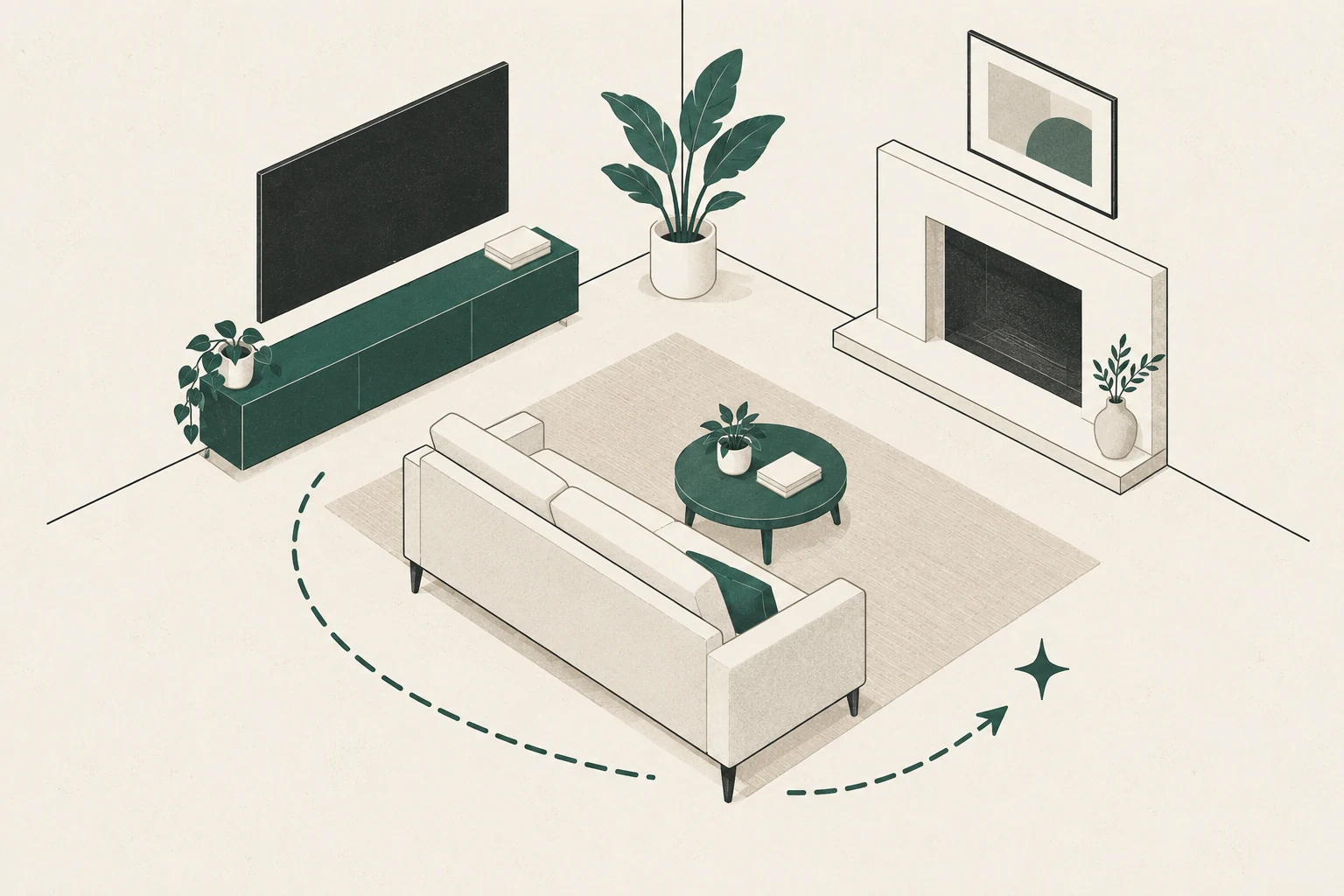
A fireplace and television both ask to be the room’s focal point, but they do so in different ways. One brings heat, flame and architectural weight; the other brings motion, sound and a specific viewing angle. Treating them as a single styling problem can create a sofa position that is uncomfortable, visually restless or unsafe.
The solution is to separate technical constraints from feng shui interpretation, then choose which feature leads during the room’s most common activity.
Safety first: Do not use a feng shui preference to override the fireplace, mantel, television or mount manufacturer’s clearances and installation instructions. Keep combustible furnishings and cables out of heat zones, preserve egress and consult a qualified installer when conditions are unclear.
Separate symbolic and technical constraints
Create two lists before drawing the plan.
Non-negotiable technical checks
- fireplace type, listed clearances and mantel conditions;
- wall temperature where a television or cable would sit;
- television mounting instructions and electrical access;
- screen viewing height and distance;
- glare from windows and lamps;
- door swings and escape routes;
- secure television and furniture anchoring.
The National Fire Protection Association advises keeping things that can burn at least three feet (one metre) from heating equipment such as fireplaces, and following installation instructions. That general safety message does not replace the exact requirements for your appliance. The CPSC also recommends mounting or anchoring televisions and using furniture designed to hold them.
Interpretive feng shui checks
- Does the room’s attention settle in one place or bounce between competing features?
- Can the main seat register the entrance without sitting in the traffic line?
- Does the seating support conversation when the screen is off?
- Does active screen imagery dominate a room intended for quiet social use?
These observations can guide emphasis, but they do not supersede safety or ergonomics.
Choose a primary focal point
Name the room’s most frequent use. If the household watches television most evenings, pretending the screen is unimportant will produce an awkward layout. If television is occasional and the fireplace anchors gatherings, make the hearth the visual lead and allow the screen to be secondary.
You can change emphasis by activity:
- a media console visually groups the television with storage;
- a quieter wall finish reduces its dominance when off;
- chairs that swivel can serve both conversation and viewing;
- lighting can favor the hearth or seating area without shining on the screen;
- doors on a media cabinet may conceal a screen only when ventilation and manufacturer requirements allow.
Compare four wall arrangements
1. TV and fireplace on perpendicular walls
This is often the most flexible arrangement. Aim the sofa or sectional toward the space between the two features, then use movable or swivel chairs to complete the conversation group.
Works well when: the room is wide enough for an angled relationship.
Watch for: a corner route that cuts through the seating group.
2. TV and fireplace on opposite walls
Avoid placing seating in a rigid line where people must turn completely for one feature. Try a sofa perpendicular to both walls with two flexible chairs, or make one feature secondary.
Works well when: the room has enough depth for a central seating island.
Watch for: traffic crossing in front of the screen or hearth.
3. TV beside the fireplace
Side-by-side placement keeps attention on one wall and may allow a comfortable screen height. Use asymmetry intentionally: a lower media unit can balance a taller firebox and chimney breast without forcing identical shapes.
Works well when: there is sufficient safe wall width and cable access.
Watch for: heat exposure, competing brightness and a cramped mantel composition.
4. TV above the fireplace
This may be the only available wall, but it is not automatically the best one. Verify the appliance and mount requirements, wall temperature, mantel/heat-deflection conditions and screen height. If the seated viewer must hold their head noticeably tilted, consider another location, a professionally selected lowering mount, or a smaller/secondary screen elsewhere.
Works well when: the installation is explicitly compatible and the screen remains comfortable to view.
Watch for: heat, excessive height, neck discomfort and cables routed near the fireplace.
Draw and test the plan
Use a measured floor plan rather than guessing from the empty room.
- Mark doors, windows, fireplace projection, outlets and fixed heat zones.
- Draw the television and its required furniture or mount footprint.
- Mark the main route through the room.
- Place the sofa for a useful door view and a comfortable primary activity.
- Add chairs to create conversation across or beside the sofa.
- Test the view to both focal points from each seat.
- Check where people put drinks, remotes, fire tools and blankets without blocking the route.
Painter’s tape can mark the sofa and media unit. Cardboard can stand in for a screen so you can check height and glare before drilling.
Quick choice by room condition
- Wide room, adjacent feature walls: begin with the perpendicular-wall plan and angle the seating between them.
- Narrow room, fireplace at one end: let the fireplace lead and test a television on a side wall before considering an above-fireplace mount.
- Only one serviceable wall: verify the over-fireplace installation technically, then mock up the screen height with cardboard from every regular seat.
These are starting plans, not installation approvals. The specific appliance, wall, mount and local requirements decide what is safe.
Manage glare and brightness
A bright window opposite the screen can make viewing difficult, while an unshaded lamp can reflect directly in it. Adjust the screen’s angle or position before defaulting to permanently closed curtains. Use controllable layers: general ambient light for movement, shaded task light beside a chair and limited accent light away from the screen. The living-room lighting guide explains the layers.
When the fire is lit, the flame and screen can compete. Try a lower screen brightness appropriate to the room, turn off unnecessary accent lights and let the household choose one focus rather than maximizing both.
Keep the room social when the TV is off
- angle at least one chair toward another person rather than the screen;
- give the coffee table or ottoman a clear relationship to the whole group;
- store remotes in one known location;
- avoid a soundbar or media unit that blocks the fireplace’s required clear area;
- preserve the route to tend or inspect the fireplace safely.
The broader sofa placement guide can help if the main seat is the unresolved piece. For the full sequence of doors, routes and furniture footprints, see living-room furniture placement.
Sources and editorial note
Fire-safety guidance: NFPA heating safety tips. Television and furniture anchoring: US CPSC Anchor It. Exact manufacturer instructions and local building/fire requirements control. Feng shui focal-point discussion is interpretive and does not establish technical safety.