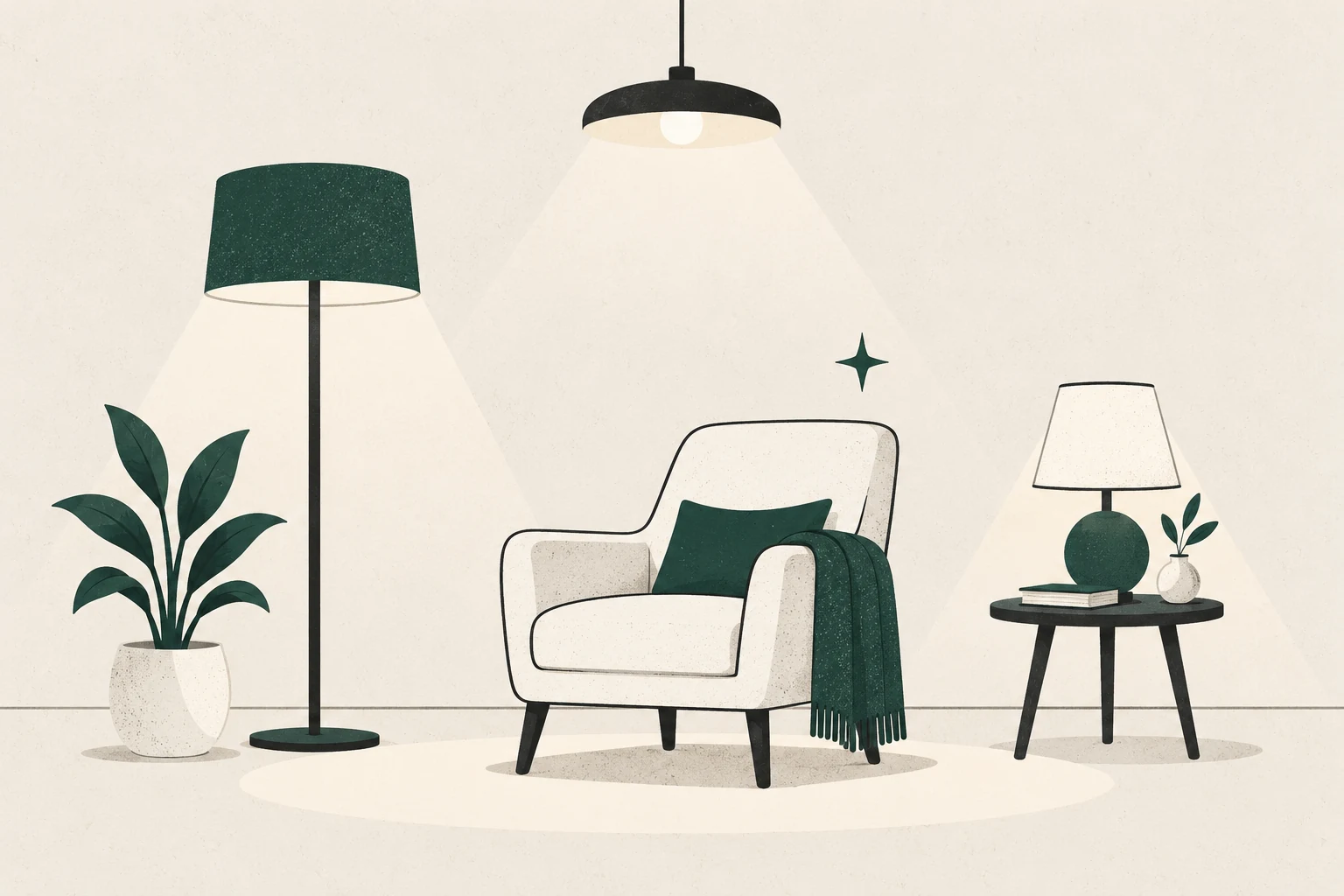
Good living-room lighting is not one bright fixture. It is a set of controllable layers that helps people enter, talk, read, watch, tidy and rest without glare or dark obstacles.
Feng shui writing may describe light as activating or lifting a space. That can be a useful way to notice a dim, neglected area, but it should not become a medical or emotional guarantee. Plan first for visibility, comfort, control and the room’s real use.
Smallest useful action: At the time of day the room feels least comfortable, turn off every lamp. Switch them on one at a time and note what each actually lights.
Observe daylight and glare
Check the room in morning, midday and evening. From the main seat, notice:
- direct sun on faces or screens;
- a bright window beside a dark interior wall;
- mirrors or glossy surfaces repeating glare;
- furniture blocking light or access to coverings;
- curtains that must stay closed because their control is difficult to reach.
Preserve useful daylight before adding fixtures. Clean glazing, adjust the furniture, open the portion of a covering that does not create glare, and keep window operation accessible. If strong sun is the problem, use an adjustable shade rather than treating all daylight as beneficial.
Layer ambient, task and accent light
The US Department of Energy’s residential lighting guidance describes three familiar layers: ambient light for basic circulation and occupancy, task light for specific visual work, and accent light for emphasis and visual relief.
Ambient: move through the room
Ceiling fixtures, wall lights or reflected floor-lamp light can provide general visibility. Aim for even enough coverage that a route does not disappear between bright islands. One central fixture may be sufficient in a small room but often creates glare and leaves corners unusable in a larger one.
Task: support the activity
Place a reading lamp so the light reaches the page without shining into another person’s eyes or reflecting in the television. A lamp beside a puzzle or craft table needs a stable base and a cord route that does not cross circulation.
Accent: guide attention sparingly
Use accent light for artwork, a textured wall or a meaningful object. It should not compete with every other focal point. If an accent fixture contributes little when the object changes, it may not deserve the energy or visual complexity.
Light circulation and conversation zones
Draw the living room as zones rather than treating every square foot equally:
- Entry and route: enough light to see thresholds, steps, table corners and changes in flooring.
- Conversation group: faces visible without a harsh overhead spotlight.
- Reading seat: a controllable task source within comfortable reach.
- Media zone: low-glare ambient light that does not reflect in the screen.
- Display or art: optional, limited accent light.
Locate switches and controls where people actually enter or sit. If a household member has low vision or limited reach, prioritize clear contrast, consistent routes and accessible controls over decorative symmetry.
Choose bulbs without unsupported wellness claims
Use the fixture and lamp manufacturer’s specified lamp type and maximum rating. Compare products using practical information:
- Lumens: how much light the lamp produces;
- Colour appearance: commonly described by correlated colour temperature;
- Colour rendering information: useful when materials and art need to look consistent;
- Dimming compatibility: the lamp, driver and control must work together;
- Rated life and energy use: relevant to maintenance and running cost.
A warmer or cooler appearance may change how a room feels and how finishes look, but avoid claims that a household bulb treats a health condition. For sleep, vision or medical concerns, consult an appropriate clinician rather than relying on feng shui advice.
Address dark corners carefully
A dark corner is not automatically an energetic problem. It may be unused because there is no activity there. Decide whether it needs a job.
- If it holds a chair, add a reading lamp.
- If it is part of a route, improve general coverage.
- If it contains art, consider a restrained accent.
- If it has no purpose, it may not need its own fixture.
A mirror can bounce an existing view but cannot create light; it may also produce glare. Read mirror placement in a living room before using reflection as a lighting strategy.
A simple evening lighting plan
- Turn on low, even ambient light before the room becomes fully dark.
- Add task light only where an activity needs it.
- Keep the screen wall free of direct reflected lamps.
- Use accent light only if it adds useful depth.
- Make one control near the exit easy to reach so the room can be left safely.
In a fireplace room, heat and equipment clearances come before lamp placement; see the TV and fireplace layout guide.
Common lighting problems and first tests
| Problem | Test before buying |
|---|---|
| Faces look shadowed | move a shaded lamp beside or slightly behind the seating group |
| Screen glare | switch off each source to identify the reflection, then change angle/position |
| Room feels flat | separate ambient and task layers instead of increasing one central light |
| Corner feels abandoned | give it a real activity or leave it intentionally quiet |
| Colour looks wrong at night | compare the finish under the actual evening lamps before repainting |
| Cords cross a route | relocate the fixture or have a safe outlet solution assessed |
Worked evening scene
In a room used for reading and television, a ceiling fixture can provide arrival light, a shaded floor lamp can serve the reading chair and a low lamp behind or beside the screen can soften the contrast without reflecting in it. The reader does not need every layer at once: general light for entry and tidying, task light for the page, then a reduced ambient level for viewing. Test each state from the doorway and every regular seat.
Make the layer responsive
The room may need bright, even light for cleaning and softer, localized light for conversation. Dimmers and separate switches can help, but only when the components are compatible and properly installed. Electrical changes belong with a qualified professional.
Coordinate lighting with the living-room colour guide and five-phase material plan after the basic routes and activities work.
Sources and editorial note
Lighting layer definitions are cross-checked against the US Department of Energy’s High Performance Residential Lighting strategy guideline. Product specifications, electrical codes and qualified professional advice control. Feng shui interpretations are presented as observational prompts, not medical or wellness claims.