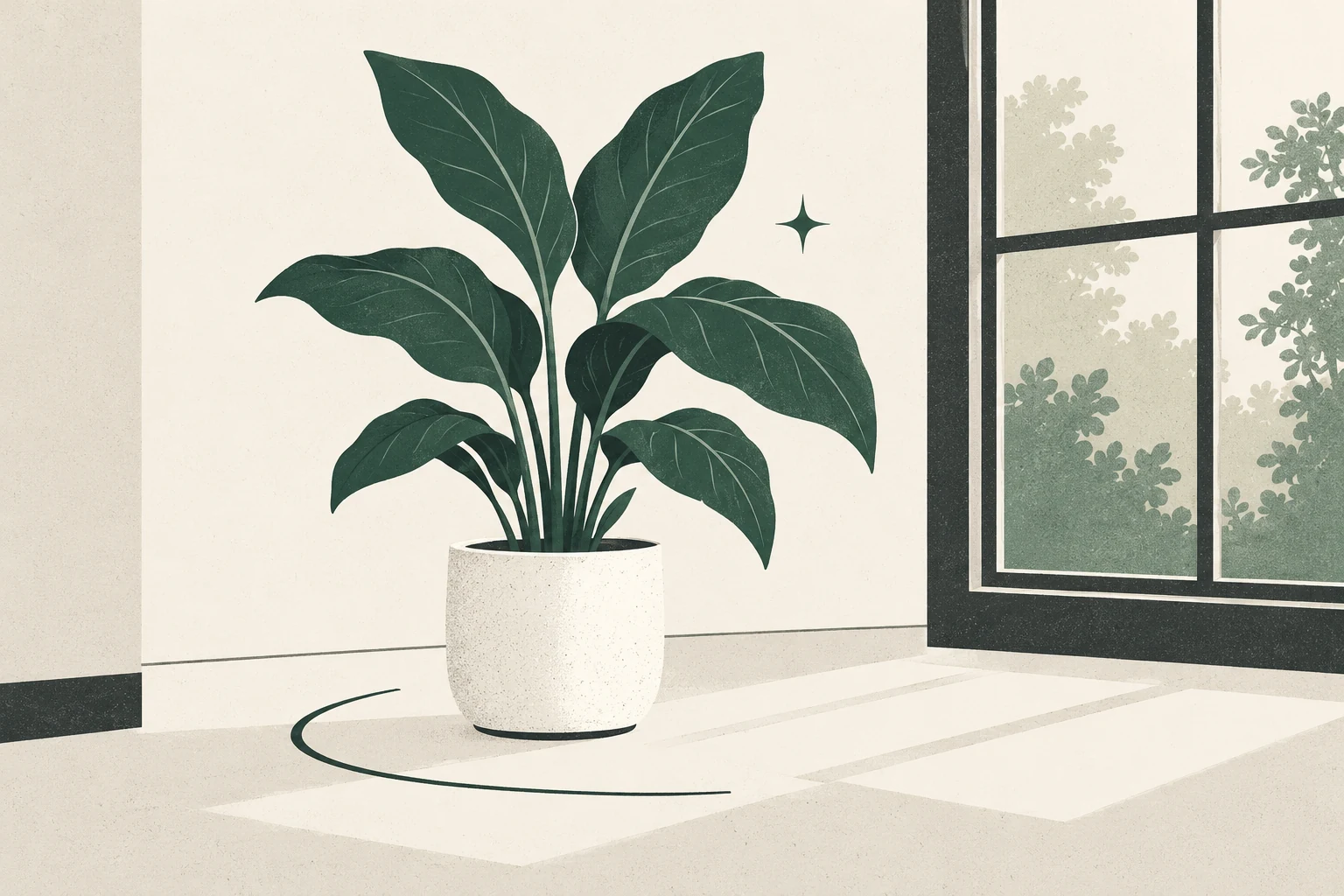
Plants are often used in feng shui to suggest growth and wood-phase qualities. But a living plant has real biological needs. The most supportive choice is one that can live in the room’s actual light, can be cared for consistently and is safe for the household.
That may mean one healthy plant, a grouping near the only suitable window—or no live plant at all.
Smallest useful action: Observe the proposed spot at three times of day. If you cannot describe its real light and access to water, do not buy a plant for it yet.
Choose for actual light and care
“Bright,” “low light” and “indirect” are not precise enough on a shop label. Note the window direction, distance from glass, seasonal shade and whether curtains are usually closed. Ask a reputable nursery for a species that fits those conditions, and keep its botanical name.
Also be honest about care:
- How often can someone check the soil?
- Who waters when the usual carer is away?
- Does the pot drain without damaging the floor?
- Is the room dry, drafty or heated?
- Can the plant be reached without climbing or moving furniture?
- Will it outgrow the position?
A plant that needs constant rescue adds work and visual decline. Choosing a durable fit is more useful than choosing by symbolic reputation.
Place plants without blocking routes
Map the mature width of leaves, not just the nursery pot. Keep door swings, window latches, vents, heaters and curtains clear. A pot should not force people to turn sideways or become a trip hazard beside a sofa.
Use a stable saucer or cachepot and protect vulnerable flooring. Tall, top-heavy plants may need a wider base or another location. Hanging plants require secure structure and must not intrude into headroom or accessible routes.
If the room’s route is already compromised, solve furniture placement before using a plant to soften the layout.
Scale and visual softness
One plant with a readable silhouette often creates more calm than many small pots scattered across every surface.
- A broad plant can soften the transition beside a tall cabinet.
- A compact plant can mark a side table without consuming its working area.
- A grouped set near suitable light can read as one composition.
- Repeated pots in one material can reduce visual noise.
Avoid using a large plant as a screen if it blocks door awareness or the only daylight. In an open-plan room, a low planting group may define a boundary without becoming a wall, provided the route stays generous.
Pet and child safety before symbolism
Identify the exact species, not only the common name. The ASPCA maintains a searchable toxic and non-toxic plants database and advises that even plant material listed as non-toxic can cause gastrointestinal upset if eaten.
Some popular houseplants—including pothos, peace lilies, philodendrons and others—can be problematic for pets. True lilies are especially dangerous to cats. Check current veterinary guidance for the exact plant and species in the home, and do not assume putting a toxic plant “out of reach” is sufficient for a climbing or persistent animal.
For children, consider choking hazards, irritating sap, thorns, heavy pots, standing water, fertilizer and soil access. A qualified pediatric or poison-control source is more appropriate than a decor list.
If ingestion is suspected, contact a veterinarian or relevant poison-control service promptly; do not wait for a feng shui remedy.
Symbolism as a secondary layer
In many contemporary feng shui interpretations, healthy upward growth and rounded or generous leaves are preferred for social spaces. Other practitioners may read species and locations differently. Treat these ideas as symbolic associations, not claims that a plant produces money, health or relationship results.
Personal meaning counts. A cutting from a family plant may be more resonant than a fashionable species, provided it suits the conditions and is safe.
Low-light and no-plant alternatives
If the room cannot support a live plant, consider:
- a seasonal branch from a safe, responsibly sourced species;
- botanical art with a calm scale;
- a woven natural fibre or visible timber grain;
- a green textile already owned;
- keeping the area intentionally open.
Artificial plants avoid care but still collect dust, occupy space and need material/fire-safety consideration. They are decor, not failed live plants.
Worked choice: low light, curious cat
In a dim room with a cat that chews leaves, a fashionable floor plant is a poor default even if it carries a desirable symbolic association. Start with the ASPCA database and a nursery conversation using the exact botanical name. If no suitable plant fits the light and household, repeat the wood tone already present in a frame or table and leave the floor route open. A no-plant answer can be the most responsible one.
A placement test before repotting
Use an existing basket, box or stool to mark the plant’s expected mature footprint for two days. Walk past it carrying laundry or a tray. Open curtains and windows. Sit in each seat. If the placeholder blocks movement or view, the plant will too.
Then check:
- correct light for the species;
- safe household fit;
- stable container and protected floor;
- access for watering and pruning;
- no blocked vent, heat source or route;
- scale that supports the composition.
For the wider object edit, use the feng shui living-room decor guide. To relate plant greens and natural materials to the palette, see living-room colours.
Sources and editorial note
Pet-safety claims are grounded in the ASPCA’s toxic and non-toxic plants database and its houseplant safety guidance. Verify the exact botanical name and consult a veterinarian for household-specific advice. Feng shui plant associations vary and are not outcome guarantees.